





Greater Manchester Savers: Our story so far

Explore any urban neighbourhood in Greater Manchester – seek out its craft groups, its over 50s exercise classes, its food banks, parent groups, and meal clubs – and there you will find amazing women.
We call them Women Warriors: the lynchpins of communities that have experienced decades of economic, social and political disadvantage, communities where the Greater Manchester Savers operate.
Women have always played a critical role in community action in the UK (and across the world). Since the onset of austerity policies in 2010 which has reduced spending on public services and social support, women have been at the forefront of the battle to provide a safety net for the most vulnerable in our society. Most of the time they are also struggling with challenging personal circumstances of their own.
The gendered nature of this community action usually goes unrecognised. It is almost always unpaid, and the cost of activities are frequently shouldered by communities themselves.
Women’s integral role in holding communities together against forces that impoverish and fragment them gives them astute insights into local aspirations, challenges, and motivations. Yet, such women are some of the least likely to have influence over the decisions that are made about their community. Places, in the context of Greater Manchester, where they and their families have often lived for generations.
This is a story of women-led change.
The booklet we are launching today takes stock of what Greater Manchester Savers have achieved so far, experiences of our members over time and the partnership support Savers would welcome, and why our approach matters amidst such challenging times.
Our network has emerged following a series of community exchanges between women engaged in poverty action in Greater Manchester and activists from South African and Kenyan affiliates of the international social movement Shack/Slum Dwellers International (SDI). It was enabled by an action research project funded under the Mistra Urban Futures’ Realising Just Cities programme (University of Sheffield) between 2017-2019. This work also draws on earlier and continuing support from the Global Development Institute (University of Manchester) and its collaboration with SDI, particularly within its teaching programme.
Most importantly, Greater Manchester Savers has been catalysed by the willingness of SDI activists in the Global South to share their histories and experiences; and by longstanding women community leaders in Greater Manchester who have brought their own experiences into this process and made it their own.
GM Savers and COVID 19
As this publication was nearing completion the world was struck by the Coronavirus pandemic. The speed with which under-resourced community groups have organised to ensure basic needs are being met in their neighbourhoods is testament to the critical role they will necessarily play in what is likely to be a turbulent future.
Together with the stark health inequalities between deprived and affluent neighbourhoods revealed by the pandemic in England and Wales, this has strengthened our belief that our work is becoming ever more important amidst mounting and multiple economic, social and environmental crises.
Read about some of our members responses to COVID 19 in Miles Platting, Hulme and Wythenshawe.
Throughout 2020 Savers are focused on adapting to the rapid changes facing their communities. We are currently learning from our sisters in Nairobi who have been busy setting up local COVID 19 monitoring committees.
GM Savers is supported by Community Led Action and Savings Support (CLASS), which provides professional support to affiliated savings groups. We are also grateful for the support of the Urban Institute at the University of Sheffield and the Global Development Institute at the University of Manchester.
More Stories
Pride in Place Manchester
Neighbourhood Planning in Hulme

New impact evaluation now available!
Looking out for each other during lockdown
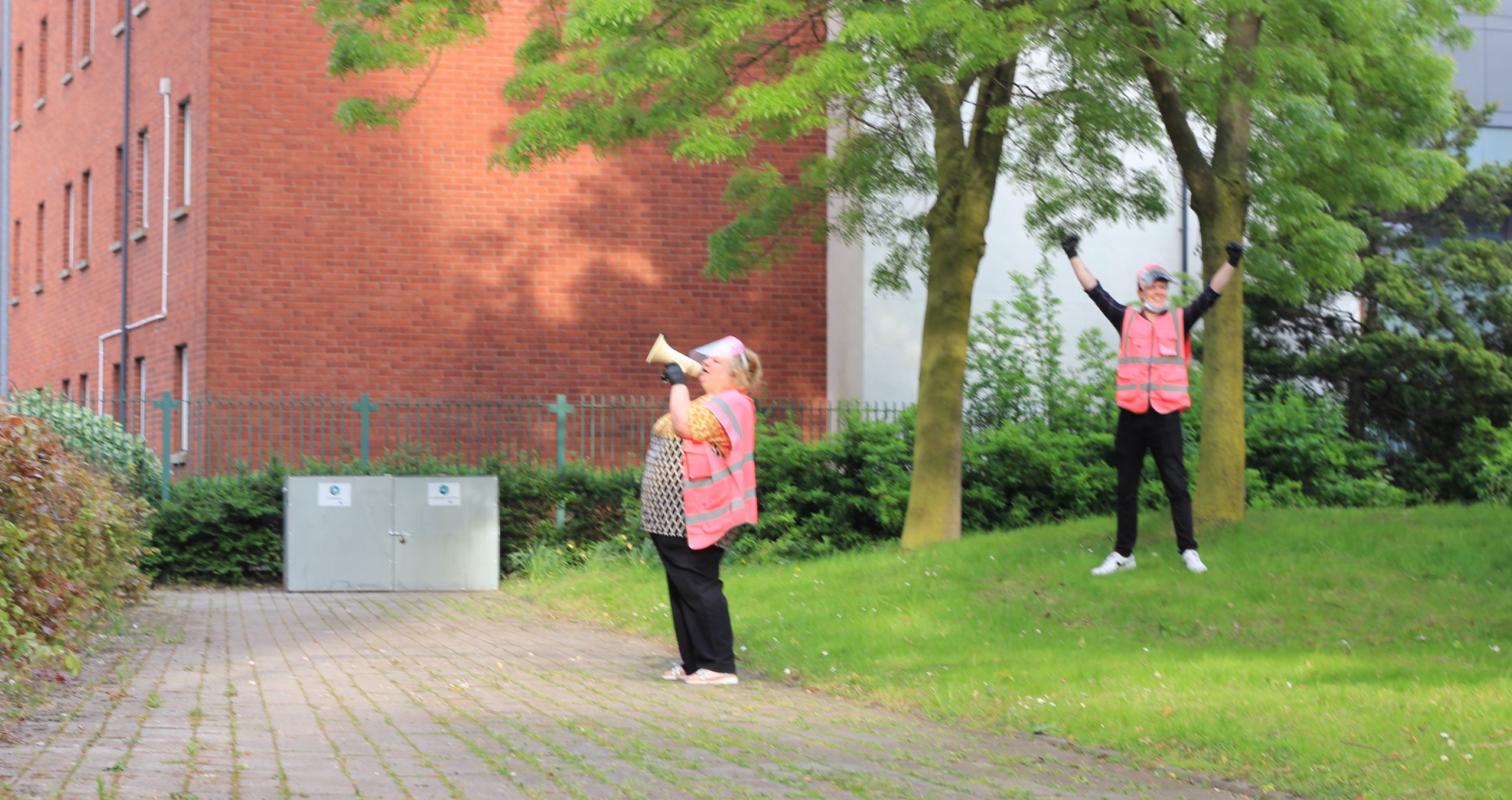
In the second of a series of articles looking at the experiences of some of our members during the pandemic, Rowena Harding asks Tina Cribbin about On Top of the World and life under lockdown in Hulme.
Living in a tower block in Hulme has challenges. Gentrification is disrupting the neighbourhood, the University’s students means transient neighbours, development takes away community spaces, and the findings of the Grenfell inquiry compound to make residents feel like sitting ducks in their high-rise homes. So when the coronavirus pandemic meant residents needed to “stay safe, stay home” it was clear that something was needed to keep spirits up.
“There are many ways to die,” said resident Tina who is part of On Top of the World, a community group based in Hulme, who use arts and creativity to reduce isolation and promote wellbeing among older people. “We had to do something before people’s mental health deteriorated.”
And so, Get Busy on Your Balcony was born which saw Tina and her co-workers Anne and Chris dancing and singing “I just called to say I love you” up to the residents of Hopton Court in Hulme much to the amusement of passing bus drivers. People sing along from their balconies and enjoy Balcony Bingo with other activities including boredom packs with jigsaws and sunflower planting.
On Top of the World are now moving on to organise events like Social Distance Disco which Tina says “give people joy and hope, and nourish the soul.”
It helped that On Top of the World and residents like Tina already had an active presence in the community. “We’d done the groundwork. We’ve had drop ins, Irish storytelling cafes, and dances. Creative writing sessions where we run our savings group and drama, circus skills and a DJ,” Tina described, in life before lockdown. She said that when they started organising the events and pushing bingo cards through people’s doors “they knew we were going to do something daft!” Tina said it’s this kind of presence in the community that’s so important to community engagement – not just during the pandemic. “Success is knowing the community. You have to know what your community needs. You have to have empathy and know the history of isolation and injustice. And the history of the people.”
Tina and the team provide practical help as well as the laughter and singing because the usual challenges of life are still going on in lockdown. “We help with advocacy, food parcels, we make sure people get medicine, if they needed crisis support with money when someone had been broken into. Older people were coming out of hospital with no-one providing care for them”.
The residents have also made a real effort to connect with each other especially people who are not digitally included. “The biggest thing we’ve done is the daily ring round. The conversations have been harrowing. We had a lady whose voice went because she had not spoken to someone for so long. [Another lady] crying down the phone line in isolation and then apologising for crying. [One gent] who had not seen his grandkids for so long and told me ‘it’s worse than the war; at least I could see people.’”
Tina explained that the residents wanted to let everyone know they had not been forgotten. She also describes that they had to work hard to make sure the fear of the virus didn’t undo all the good work the community had been doing. “We all have to use the communal spaces if we go out. There’s one lift. And one hand sanitiser for the 80 of us. There was a lot of panic, anxiety, you could see the fear in people’s faces when you used the lift.”
There’s more to come from the residents of Hulme. Older residents are being helped to get online with Whatsapp and Facebook groups. A new community monitoring initiative is being planned with CLASS and some of the other GM savings networks who are learning from their sisters in Nairobi. Street theatre is planned, along with more dancing on the grass and bingo on the balconies.
And importantly this era won’t be forgotten. A script is being written which captures the stories and issues of living in Hulme during lockdown, and will be performed as a play for residents. It sounds like a play with lessons for everyone who wants to live in a better community long after the pandemic is over.
More Stories
Pride in Place Manchester
Neighbourhood Planning in Hulme
New impact evaluation now available!
Dot the do-er!

In the first of a series of articles looking at the experiences of some of our members during lockdown, Rowena Harding asks Dot Lomax what has been happening in Miles Platting.
“If you want to find something to do in the community you will find it,” says Miles Platting resident, Dot.
Dot, by her own definition is a resident that does things in the community. She’s a member of one of the first GMS groups to set up – Miles Platting Savers. She is now also using that experience to support Ridgway Street Savers as a committee member. She’s a regular at the community garden and she is also involved in Many Hands Craft Collective, Monday Movers at St Georges Youth and Community Centre, and a new collective of local groups called Miles Platting Community Network.
Dot has been keeping busy during the lockdown, helping to put together food parcels with other Ridgway Street Savers working with Reverend Ellie Trimble at the Parish Church of the Apostles. She’s especially keeping an eye on those who used to come to the Friday coffee morning at the Apostles where the Ridgway Street Savers began. The coffee morning was a place where local residents could enjoy each other’s company, have a laugh and sometimes even a bit of a dance – but people could also take home a few items of food. Now, they lack the company of the gathering and a convenient way to stock up on essentials. Most members are older and have underlying health conditions. Sadly, three members of the group have passed away in recent weeks. “The loss feels bigger somehow”, explains Ellie, “because the group have not been able to honour their lives together and some of them have been meeting up for twenty years or more”.
Dot says she’s lived in the community all her life, and together with Ellie at the Apostles and other volunteers, they have been keeping in touch with as many residents as possible during the pandemic’s lockdown. “We’ve got phone numbers and people know and trust us so they ring if they need anything. Ellie puts letters through the doors and there’s a magazine (from housing association Adactus) that comes through people’s doors.”
But Dot worries about people who don’t reach out for help. “There’s people falling through the net,” she says “More people need support. We are still missing out people who are not coming forward. There is lots of pride and people will say ‘keep it for people who really need it’. How do we get in touch with those people? There are a lot of people struggling.” The Miles Platting Community Network are discussing these questions now to see what more can be done.
Dot assures her 4-year-old granddaughter living across the way that she is doing ok every time she sees her. But Dot knows there are people out there who are not. How to reach those people?
That’s the million-dollar question that’s become even more important now that the pandemic has given people more reason to stay behind closed doors.
More Stories
Pride in Place Manchester
Neighbourhood Planning in Hulme
New impact evaluation now available!
“With savings we can do wonders”: a Manchester-Muungano exchange
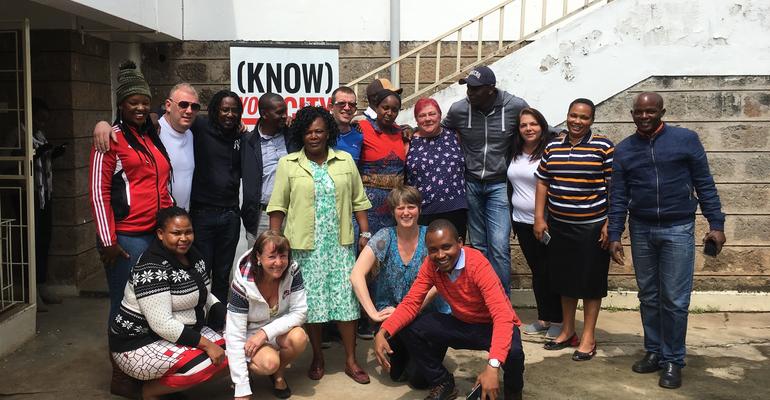
In June 2018, six Greater Manchester residents went on a learning exchange visit to Muungano Wa Wanavijiji (the Kenyan Slum Dwellers Federation) in Nairobi as part of the Realising Just Cities project: ‘Community-led organising: Seeing the inner city from the South’. In the spirit of experience sharing and knowledge exchange, the Greater Manchester team decided they would like to share some extracts from their peer-to-peer interviews and a final joint reflection with a wider audience. Some background information precedes these reflections.
“It has been a ritual, especially in Kenya, that we get knowledge from the West and we bring them to Africa so we can learn from them… So it is a good platform that we can now share our experiences and they can be taken back to the West as best practices…” Rashid Mutua, Chair of Muungano Wa Wanavijiji
Who is Muungano?
Muungano wa Wanavijiji (‘Muungano’) is ‘the Kenyan federation of slum dwellers and urban poor people’. It is made up of groups of slum residents from cities and towns across the country. It is the Kenyan affiliate of an international social movement called Slum/Shack Dwellers International which joins together savings-based movements of low-income women in 32 countries across the Global South. As well as federating together savings groups in settlements and cities across Kenya, Muungano partners with the Akiba Mashinani Trust and a technical support agency called SDI Kenya. Together they make up the ‘Kenyan Alliance’.
Susan Wanjiru, Muungano Leader in Kambi Moto explains how savings prepares communities for collective projects:
What is “savings” or “savings-based organising”?
Local residents agree to begin saving together and follow the approaches used by affiliates of the international social movement Shack/Slum Dwellers International. This means that they agree to manage their own activities and set their own rules to ensure that anyone can participate regardless of income.
Savings scheme members save daily or weekly. For daily savings ‘collectors’ visit each member and savers can put any spare change they have into their savings account. This daily visit means that they have the opportunity to save whenever they do have some change but also means members can find out about each other’s welfare and support each other. These savings form a pool of money. Some savings groups also provide emergency and income-generation loans to their members.
As savings group members work together to gather and manage their funds, they increase their financial management skills and build trust between each other. Over time, as they meet often, they talk about their problems and their needs. Together they begin to think about how they can address larger issues of housing and basic services. Savings schemes form Federations. Federations are strengthened as their member savings groups visit other savings groups in their own city and then others in other settlements and cities – and also other nations. These exchanges are inspirational and build capacity.
Working together, savings schemes can ‘enumerate’ their settlements – doing their own census as they map and survey their neighbourhoods. They use this information to discuss their priorities. Backed by their savings and maps and household data from enumerations, savings schemes talk to the authorities about how they can address their need for land tenure, access to water and sanitation, improved housing, and many other issues.
Elizabeth, Community Mobiliser in Mukuru Special Planning Area explains savings and bottom-up neighbourhood planning:
Savings in Greater Manchester
In 2016 after an exchange in Manchester with the South African Alliance, a group of women based in Wythenshawe called Mums Mart decided “savings” would benefit their community and set up a new savings scheme. They also visited the South African Alliance in July 2017. They have since expanded from a small number of friends saving together to an initiative of 40 members which is now working together to renovate an old apartment into a shared community space for the neighbourhood. The “Mums Mart Savers” have begun reaching out to other neighbourhoods across Greater Manchester. Residents from Brinnington (Donna and Jeni), Lower Broughton (Sue), Collyhurst (John) and Benchill (Sharon and Mark) joined together to form a delegation for this latest learning exchange to Nairobi.
Reflections on the exchange
What reflections do you have about the exchange so far?
Mark: We’ve all seen African nations on TV… I really did think it was wrack and ruin… and what I found was, yeah, there’s tough conditions but they deal really well with it
Donna: I think it has been a really good experience to see a different community from what we’re used to, to see how people are living… all the people we’ve met have been absolutely lovely and really welcoming. They really want to show us this side of their community, they really want us to understand it, learn from it and it’s been really good… The way they save makes a difference…
Jeni: And you can see their changes
Donna: You can see they’re advancing
Are there ways in which being in Kenya and visiting these communities has changed your perceptions about life in the UK or about your own neighbourhood?
Sharon: I’ve come to the conclusion that there is no community left in England. The way these people work together… But I don’t think it would take much to bring it back… I think there are little snippets of communities out there.
Sue: It comes together when there is some kind of event… like when we got flooded, the community came together but it takes something like that to bring them together.
Jeni: Yeah, they don’t just do it like that, it takes something to happen.
Sharon: I think our communities could be brought back quite easily… I think it’s just going to take us to sit round and see how… Cos it is hard. They seem to find it so easy to get people mobilised.
Mark: When we get home from work we shut our front door… That’s the last thing that would happen over here… The civilisations that are deemed behind the Western White world if that’s the right phrase I mean no offence by it… instead of looking at us and saying ‘we want that’, what I think they should be doing is looking at us and going ‘we don’t want to make that same mistake’.
Donna: I just think there is a bit more sense of care over here. They seem to care about each other and care about what they want, you’ve not got that back in the UK. You’ve got a lot of people that stick to what they know and stick to who they know, and they don’t care about the wider community, they don’t care about their neighbours like they used to.
What similarities are there between your community and the communities that we have visited?
Donna: In our country and over here obviously right across the board there is a problem with housing. Although it is slightly different it’s still a problem with housing…we’ve got homelessness at home, they’ve got the slums here…settlements… that’s their option over here…it is poverty it’s just on a different level.
Mark: I think there’s loads. One, it’s obvious that generation to generation are trying to make a better start for their next generation. You want better for your kids. Which I think is the same in ours. I think the worry of having a roof over your head is exactly the same as ours.
Sharon: A lot of the time for us it’s, we’re worried about, where’s the next meal coming from? Where’s the next rent payment coming from? How are we going to pay the electric?
How has the exchange made you feel about your ability to do things in your own neighbourhood? If you are running or planning a savings scheme – what will be easy and what will be challenging?
John: I feel like I could do more, we could be more productive. Being over here has taught me that we can do more in our communities
Sharon: I think it’s going to be hard to get people motivated and involved… because people get an apathy… like ‘nothing’s happening’ and they will disappear again…so I think we are going to have to really think hard about keeping people interested.
Jeni: I think the getting people together will be easy because I know plenty of people that as soon as you mention that to them they are going to be straight to it
John: It’s keeping them.
Jeni: Yeah its keeping them… we need to give them an incentive to keep coming…
Sue: I mean once you get them in and they do start that saving…
Jeni: Yeah, they might like to see it working first before they try…
Sharon: That’s an easy thing for me because ours is working.
Donna: I think we’ve kind of decided, we’re going to start off small and just try it…
Jeni: We just need to get it in place and see how it goes. If it works it works. If it doesn’t, well…then we’ll have to find something else… I don’t think it will be a problem I think people will come and they’ll stay I really do
Sharon: Just take it slow and don’t have any expectations… don’t think ‘Yes! This is going to take off and I’m gonna have 200 savers in a week. You know what I mean? Just take each week as it comes and let the word get around…
Mark: I always go back to sport…talking about savings is just like talking about boxing… it’s a tool you can use
Sharon: That’s what some people don’t get, they think we just want your money, whereas really we just want you to become part of the community…I quite often say to people, people who haven’t been for a while and I contact on social media or whatever …and they say oh I’ve not got any money, I say, you’ve not got to have any money, just come along to savings, you don’t have to save, just come along to join us!
If you would like to be in touch with any of the participants in the Nairobi exchange, or would like more information, contact Sophie King at the Urban Institute, University of Sheffield.
More Stories
Pride in Place Manchester
Neighbourhood Planning in Hulme
New impact evaluation now available!
When you get a front door, remember to leave it open

A Manchester-South Africa exchange reveals striking similarities in the dynamics of urban inequality.
“It’s all about trust” said Marie Hampshire, two days into a week-long community exchange with members of the South African Alliance in July 2017, a grassroots movement of women-led savings schemes affiliated to Slum/Shack Dwellers International or SDI. Marie is a member of Mums Mart, a women’s group from Benchill in the British city of Manchester that brings low-income families together around food, monthly markets and, most recently, a new kind of savings scheme.
Each member saves small amounts with the support of their local group, and in the process of coming together the group learns about their needs and challenges and tries to respond collectively. Mums Mart was introduced to savings-based organising after meeting members of the Alliance in Manchester a year earlier. Now, other groups in the city are starting to explore how women’s savings federations could rebuild trust and solidarity in their neighbourhoods.
More Stories
Pride in Place Manchester
Neighbourhood Planning in Hulme