The Cost of Living Crisis in Aquarius Tower Blocks

Darren | 20 Sep 2022

“I am having to reduce the quality of food, so I only buy fruit and vegetables at the weekend. Then I can survive on flour-based cooking.”

From 11-16 July, a coalition of organisations in the Aquarius Estate in Hulme, carried out a survey across six tower blocks in response to the mounting cost of living crisis.  

Community leaders from a dedicated network of groups including Aquarius Community Savers, Aquarius TARA, Epping Street Warriors, and Hulme Tenants Union spent six days knocking on every door across the six blocks and distributing 350 booklets detailing Support & Services available to tenants & residents in Hulme

Bernard Sudlow & Roy Bennett explain the motivations behind the survey and booklet distribution.

Tenants were supported by CLASS and GMTU. Their aims were:

  • to signpost residents to the range of support services available to them in Hulme;
  • to link as many people as possible into local solidarity and support initiatives;
  • to carry out a survey which would take a temperature test of the impacts of rising costs after stories had emerged of people already struggling to pay for electric and food.

83 surveys were completed in total including 13 with residents of the St Georges and Aquarius estates who attend On Top of the World Project’s Seanchai café at the Aquarius Centre on Wednesdays.

Key Findings

The findings fit into four broad areas: the impact of rising costs, problems with housing, access to the doctors and other medical services, and access to services and information, particularly around money and debt.

Gillian Edwards and Sally Casey reflecting on the crisis in living standards and access to services.

Despite surveying the blocks in the middle of July, over a third of participants were already having to cut back on food and energy use, and some were already skipping meals.

38% described their financial situation as ‘finding it quite difficult’ or ‘finding it very difficult’ while 35% said they were ‘just about getting by’.

“I am using the shower at the local leisure centre so I don’t have to use my shower at home. I only shop at ALDI as it is cheapest. I don’t have anything switched on except the kettle and the TV. I cook after 11pm as the electric is cheaper at that time.”

In discussions with residents, many said they couldn’t access the services they need.  12% of participants said they cannot access the local services they need this year. 35% of participants said they can only sometimes access the services they need this year. Only 31% of respondents said they can usually access the services they need.

The three most common services that were raised in conversations with tenants were housing, doctors surgeries, and money advice – including debt advice.

“My main difficulty is getting repairs done. Like our toilet. There was a leak from the ceiling from the flat above, and about 2 or 3 months ago they sent a surveyor around.  But still now, no-one has come back to repair it, and we are living here with two young children.

Bernard Sudlow & Emma Cooper call for collective action through a new Aquarius Neighbourhood Forum.

While the most significant drivers of the cost of living crisis are national and global in nature, community leaders in Aquarius believe that through local collective action and appropriate collaboration between local agencies, the worst impacts of the crisis could be avoided. Over the coming weeks, GMTU and CLASS will be supporting tenants to use these findings to approach a range of local agencies and explore ways to ensure Aquarius tower block tenants and residents are supported through the difficult winter ahead.

You can access the full report here.

Quotes shared within this article were recorded as close to verbatim as possible during tenant-led interviews for the cost of living survey exercise.

Introducing…

Darren | 10 Sep 2022

We are really happy to introduce Dr Vicky Simpson as Network Development Coordinator at CLASS!

Vicky began work with us part-time in April this year and is supporting Community Savers groups with financial governance, digital skills and coordinating network-wide meetings and events.

We asked Vicky what interested her in working with CLASS and Community Savers and what she has most enjoyed about her role so far:

“When I am not working for CLASS I am a Research Manager at the Urban Institute, University of Sheffield. Community Savers grew out of an action research partnership which ran from 2017-2019 called Community-led Organising: Seeing from the South so I knew a bit already about the great work they were doing. This included learning exchanges with the South African and Kenyan affiiates of Shack/Slum Dwellers International and experimentation with their social movement methodology. I was interested in the role at CLASS as the ideas of that original project have now become even more developed and I was really happy to take on a role that would support that process.

I think the work that Community Savers are doing is really important. A couple of years ago I was involved in a local campaign in my community to save land from large scale housing development. From a small group of local residents, the Dane Bank Green Space group was formed, and after years of negotiation with the local council, the group won its fight and was handed a long-term lease to retain the space. Last month Dane Bank Group Space officially opened to the community with its fishing ponds, wild garden meadow and forest school. Having direct experience of how powerful community action can be attracted me to this role with CLASS.

I have been in post for about 5 months now, and looking back I am amazed with all the activities I have been involved with already. For example, I have worked with the groups to identify and addresss ICT equipment and skills development needs; I have visited all the savings groups at their community meetings and we have begun to strengthen our relationships; helped coordinate a learning exchange of the UK Savers to our colleagues at Muungano Wa Wanvijiji in Nairobi and attended a 3-day retreat with all the teams in Snowdonia. In addition, working at CLASS has enabled me to develop my own skills and knowledge: in five months I have already joined in with Community Savers training on accounting, small grants funding and First Aid!

The community sector is fast-paced and sometimes a little overwhelming, but massively inspiring. I am in awe of the Savers leaders that I have had the privilege to meet and work with. They are unpaid volunteers, and I am amazed at how many different community projects and initiatives that they are involved with that benefit their communities. I love the ethos of the Savers Groups as they are women-led and bolster those from working CLASS communities that have been disadvantaged over time. As my own personality lends towards being supportive and wanting to be helpful, I think I fit into the groups well and like the idea of helping community members develop their own ideas. I have enjoyed the face-to-face interaction with all the Savers and meeting lots of strong, dynamic, funny, knowledgeable and caring women. Seeing the groups being supportive to each other inspires me to want to be a better person.

Having just returned to work after a quieter period over the summer, I am excited about the future. The next couple of months will soon pick up pace. For example, we are supporting the savings committees to move from paper records to digital accounts; we are recruiting a new cohort of digital inclusion volunteers to support the groups with ICT skills; and I am looking forward to meeting Kenyan colleagues from Muungano Wa Wanavijiji when they visit Manchester in October. 

Community-led development and climate action in Miles Platting

Darren | 31 Aug 2022

In 2019, members of Miles Platting Savers travelled to Nairobi, Kenya, for a five-day learning exchange with leaders of Muungano Wa Wanavijiji. Together with delegates from Sharston and Brinnington, they were inspired by the way that housing activists had brought their communities together to gather data, map their settlement and set priorities. From there, they worked with local government to ensure people’s needs were recognised and local services and infrastructure were improved. The Manchester groups visited community-led housing projects and community build schemes and saw how co-financing could achieve local ownership over community facilities, protecting and maintaining community assets.

On their return, Miles Platting Savers began to create a map of their neighbourhood tracing the history of their area and the positive and more challenging impacts of ongoing regeneration. This was undertaken with other local residents and members of Community Grocers, working with researchers from the University of Sheffield.

Community conversations revealed that there was widespread anxiety among residents about the rapid changes taking place around them. In response, in November 2019, Miles Platting Savers called a meeting of local community groups to explore how to work more effectively together and ensure local residents had regular access to information about the neighbourhood.

At this meeting, Miles Platting Community Network was born – strengthened in 2021 by a merger with Miles Platting Age-friendly Neighbourhoods Board to become:

Miles Platting Community & Age-friendly Network: MP-CAN!

In just three years, and in the midst of multiple crises, this collective of local community leaders has achieved amazing things together. Here’s a snapshot of their brilliant community action…

Miles Platting PFI: a brief history

To understand how and why MPCAN have become such a force for good in their neighbourhood, a brief history of the regeneration that residents have been living through is needed.

In March 2007, Manchester City Council (MCC) handed over the maintenance and management of nearly 3,000 homes in Miles Platting to the Renaissance Miles Platting consortium on a 30-year contract. Costing £160m in government funding, plus a comparable amount invested by the private sector (to be paid back to private investors over the 30-year contract period), the plan was to refurbish up to 1,500 council homes in the area and build an additional 1,000 homes for direct sale on the market, while demolishing 300 more as part of the redesign of the estate. Importantly – alongside the PFI contract – the council also developed a funding partnership for a Joint Services Centre including partners such as the NHS and Adactus Housing Association (now Jigsaw Homes). The centre was to include a range of NHS services, including three GP practices and a pharmacy, as well as a community hub incorporating: a new library, new sports facilities, advice and information services, services for young people, and spaces for community, recreation and leisure use.  

The area at the intersection of Oldham Street and Varley Street was also intended to host retail facilities and a replacement swimming pool. The original swimming pool and library were demolished under the PFI regeneration.

Original site map for the community hub

Unfortunately, the 2008 financial crisis led to funding for the replacement community facilities being cut. The community were left with none of the community facilities that were supposed to be introduced and have to date experienced the demolition of 240 homes for social rent with only 22 replaced.

Happily, the council have retained ownership of the land where the joint services centre and community hub were supposed to be located.  MPCAN are now advocating for the development of community facilities or housing for social rent on this site.

MPCAN in action 1: Data gathering, mapping and visioning

Within this context, the first stages of MPCAN’s work were to gather information about neighbourhood change over time and map out losses and new developments across the neighbourhood.

MPCAN were supported by URBED and CLASS to carry out a consultation with local residents about priorities for the area alongside existing plans under the PFI. This built on all the fantastic consultation and prioritising work carried out by the Age-Friendly Neighbourhoods board from 2016-2018.

URBED then supported leaders with mapping and land registry searches to identify which areas of Miles Platting were managed under the PFI contract and to understand land ownership and development plans on remaining sites.

Together, they developed a new report: Miles Platting: A vision for our neighbourhood

This highlights residents’ priorities for the future of the neighbourhood and potential sites where new community facilities could be developed or community-led improvements could be made in partnership with local agencies and authorities.

MPCAN in action 2: Climate Action

From 2020, the momentum shifted to action and one of the first achievements of MPCAN was to successfully register Shetland Road Green as an Asset of Community Value with the City Council with support from local councillors.

This created the impetus to think in more depth about how to achieve the ‘improve our green spaces’ priority from the network vision. At an URBED-facilitated ‘Green Infrastructure’ workshop in November 2021 leaders established the MPCAN Climate Action Group (CAG) which has three key objectives:

  1. Conservation: ecological survey and ‘citizen science’ wildlife recording, followed by habitat creation and inter-linking
  2. Canal upgrading: cutting back and beautification of overgrown areas to encourage more walking and cycling; planter construction and wildflower planting to develop ‘green fingers’ into and out of the canal-way
  3. Protection, improvement and development of green and wild spaces including tree protection and planting, wildflower meadow patches and ‘rivers of flowers’ for bees and butterflies

Supported by Jenna Ashton (Creative Climate Resilience, University of Manchester) and Ash Farrah (MCC Climate Change Officer), the CAG have created a map of 20 green or disused sites across the area for surveying and potential improvements and have action-planned around five of these sites since February 2022.

Dot Lomax, a local resident and community leader explains:

We do ‘neighbourhood walkabouts’ – so we go and visit somewhere and door-knock the houses around that site to chat with people about how it’s used and what people would like to see. It means we can meet people and let them know who we are as well – and then we make some plans for that site and ask people what they think.”

Residents surveying green space by the Rochdale Canal, February 2022

Members are now working with the Canal and River Trust, and Lancashire Wildlife Trust on ecology surveys and citizen science activities to identify local species and develop plans for appropriate habitat creation and wildlife corridors through the neighbourhood, and with Groundwork, Creative Climate Resilience project (University of Manchester), and Jigsaw Homes on green space improvements.

Ellie Trimble a local resident and Rector shares reflections on the first of these sessions led by Russell Hedley at Lancashire Wildlife Trust:

“It was so lovely spending time in one of our remaining green spaces as Russell completed an inventory of wildlife and native plants. We all learnt such a lot and had fun at the same time, especially our young families who ran around very excited to point out many different butterflies including some that Russell was very pleased to see so close to the city.

We learnt that some of the wildflowers that we thought were weeds are the reason we have so many butterflies which is great news as we all know weeding is hard work!

The children didn’t like the wasps that were swarming around one plant in the garden until we learnt that they were honeybees which was amazing and far more welcome. What is even more amazing, is that since that event, some of the children have been visiting the garden every evening to water the plants.”

Ash Farrah, Climate Change Officer for Manchester City Council shared:

“It’s a pleasure to support the MP-CAN Climate Action Group, the commitment and enthusiasm from the group’s members is clear to see at every meeting. To my knowledge, MP-CAN CAG is the only climate-focused community group in all of North Manchester. They are leading the way.” 

MPCAN in action 3: St Cuthberts Action Group

This group was established by St Cuthbert’s Parochial Church Council after a long process of assessment and reflection within the church concluded that the building was in too great a state of disrepair and needed to be redeveloped.

The PCC resolved to work in partnership with MPCAN leaders and local residents on a community-led redevelopment of the St Cuthberts site. The PCC aim to retain a space for worship while achieving their Mission Action Plan to nurture and support their parishioners and the local community, especially in matters of social justice and reducing deprivation and exclusion.

The early stages of this work are being match-funded by The National Lottery Community Fund and an invitation to tender for project management services has recently been advertised.

The first step will be an extensive neighbourhood-wide consultation on the facilities that local residents would most value and ensuring that as diverse a set of residents as possible are able to share their ideas and any anxieties or concerns.

Leaders from the action group are now going out on visits to community hubs and mixed-use social centres across Manchester to gather ideas and inspiration. Most recently, they had a fantastic visit to The Carlton Club in Whalley Range to learn about the journey of initiating and developing a community-run social venue. MPCAN are looking forward to a long and fruitful relationship with committee members at the Carlton Club and hopefully many others along the way who can offer guidance and moral support as they embark on their own exciting project!

Visiting The Carlton Club

Anne Worthington, a long-term resident and community leader said:

“I think the work MPCAN is doing with regards to the St Cuthberts site is SO important. With the support of the PCC, we hope that along with a space for worship, a valuable community social space can be created to replace the existing church building which is sadly in poor shape. Visiting other community ventures is really inspiring.”

If you would like to find out more or connect with MPCAN please email: milesplattingcommunitynetwork@gmail.com.

Surveys for Social Justice: Ageing well in place in inner city Manchester

Darren | 27 Apr 2022

“I am most proud of being part of Community Savers because I know I am in a movement based on social justice. It’s also the place I’ve been challenged the most but also learned the most.” Tina Cribbin, community activist and member of Aquarius Community Savers.

This is the story of how a women-led social movement methodology from the Global South has enabled older tower-block tenants in inner-city Manchester to address health and social inequalities experienced by elderly people living in the heart of the city.

Activists affiliated to Shack/Slum Dwellers International (SDI) have been visiting Manchester to teach at the Global Development Institute on an annual basis since 2011. As a movement that has proliferated across cities of the Global South through community-to-community learning exchange, they soon requested to meet with community organisations and projects during their visits. SDI affiliates always seek out opportunities to learn from other communities about their experiences and strategies for addressing situations of disadvantage.

In March 2016, these exchanges catalysed something exciting and transformative: the first SDI-style savings group was established in Manchester organised by Mums Mart community association in Wythenshawe. Once the torch was lit, the fire spread quickly. Partnership between the Global Development Institute, University of Manchester and the Realising Just Cities programme and University of Sheffield enabled a series of international visits from community leaders in Greater Manchester to first the South African, and then the Kenyan SDI affiliate, to take place.

Six years later, and despite the hurdles presented by the COVID-19 pandemic, there is now a network of five neighbourhood-based savings initiatives spanning Manchester, Stockport and Sheffield. Community Savers is supported by Community Led Action and Savings Support, which helps to facilitate the savers network, establish new groups, and continues to support leaders to exchange with their Kenyan mentor federation Muungano Wa Wanavijiji.

Community Savers groups have made amazing progress supporting their communities through the pandemic, developing poverty reduction projects and innovations, and increasingly developing new visions and partnerships for their neighbourhoods which can address the long-term disadvantage experienced in some of the lowest-income neighbourhoods in Greater Manchester and Sheffield.

One of the most exciting new partnerships to emerge from their efforts is the Ageing Well in Place in Hulme initiative which brings together tenants, their housing provider, the Manchester Local Care Organisation, local voluntary and community sector organisations and two universities to co-produce solutions for elderly and vulnerable tower block tenants living in the Aquarius estate, in inner-city Manchester. The impact has been so profound that one of the leading tenants’ group, Aquarius Community Savers, have recently been nominated for a University of Manchester Making a Difference Award.

Here, Tina Cribbin, long-term Hulme activist and member of Aquarius Community Savers shares her experiences of adapting the idea of enumeration and profiling from the SDI toolkit for her group’s own local purposes.

When I first came into contact with Community Savers, I had been active in the community for thirty years from being employed as a youth worker, social worker, women’s support officer and many more that were unpaid.

Over time, I learned that if I tell my truth and my community’s truth through art, people are more likely to accept what I am saying. I published a poetry collection called Classphemy, wrote a play Can you hear me from up here? through On Top of the World project, and set up two writing groups including Hulme Writers, which I run through On Top of the World.

These creative activities have been focused on speaking truth to power about the negative impact of university and inner-city expansion and gentrification on my community.

You can imagine what my thoughts were when I was approached by Sophie King (Director of CLASS), who was at the time a university academic, to participate in a gathering called “inner-city exchange”. Universities held lots of negative connotations in Hulme as they have basically taken up the land where we used to have social housing and community facilities. I had zero interest in working with another academic. So much so, that I even wrote her a poem about why.

Sophie recognised my sceptism about academics and asked Sharon Davis from Mums Mart to come and talk to me about Community Savers. I now know that this is how Community Savers operates – community to community, woman to woman. Sharon spoke my language and I felt safe that I wasn’t dishonouring my community by participating.

I was able to totally grasp what the community savings were about and the history of how it grew out of exchanges with Shack/Slum Dwellers International federations as Sharon had already been to learn from community activists in South Africa and Kenya.  It made sense – it was much more than a savings group it’s a social movement that is run by women not so different from me. I, like every woman on the planet, know that the personal is the political. Every penny saved is an act of resistance and challenge to those who control our lives worldwide.

It was impossible not to want to be a part of something so amazing!

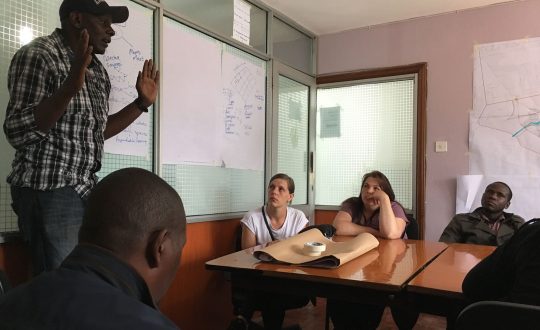
I was so impressed when I met Anastacia Wairimu (see header photo) who is a lifelong leader of the movement in Kenya and who came to visit us in Hulme in 2019. It made me realise just how big the movement is. And how organised they were in their communities. Anastacia showed me clear examples of how the movement worked with women to finally getting their own homes constructed, getting roads built, getting electricity and water. It inspired us when she talked about collecting information as evidence to bring to the authorities. Although we lived worlds apart, we were together in being resistant to inequality and understanding that working together as women, we can bring change.

Inspired

Inspired from Anastascia’s visit, and together with On Top of the World Project where we run a weekly drop in with older tenants, we began to think about the issues facing our community and particularly tenants at Hopton Court where I live, and where 75% of tenants are aged 50 and over. We knew that many of these tenants were in vulnerable or difficult circumstances and often had poor health but were not receiving the care they needed. We were aware that some people were hiding their frailty for fear of being moved away from the place they call home. There was a lot of isolation and nowhere for us to come together during the pandemic.

CLASS supported us to develop a partnership with two academics at the University of Manchester (MICRA) and MMU (MSA), and our housing provider One Manchester. We did some interviews with tenants and other people like local GPs which enabled us to get an overview of some of the challenges tenants were facing. However, this only captured the experiences of a handful of tenants.

With support from a PhD researcher at the University of Manchester, Whitney Banyai-Becker, we were able to get some social responsibility funding to take forward a tenant-led survey of our whole block.

This was different to other research projects I’ve been involved in because the actual questions were designed by the tenants themselves. We felt ownership of the project. We worked with Whitney and Sophie to co-design the whole thing. We were able to share our expertise about how to approach our neighbours and what would be needed to encourage their participation, also about safety and protecting people’s privacy and confidentiality – we know our own community well and we knew what people’s concerns would be ahead of time. Whitney and Sophie could share more of the academic side and make things systematic, ensuring information was recorded systematically and that surveys were written up and analysed, which meant they could do the report writing at the other end of the process.

We began by talking with residents about what changes they would like to see at the block, but the questionnaire covered wider areas such as access to services, social isolation, health and wellbeing and feelings of connectedness. We were a bit pessimistic when starting because many people didn’t answer their doors. But we kept going at different times and once people got the idea that it was their neighbours trying to make improvements, they were willing to engage with us. We got over 50% response rate which far exceeded our expectations.

Although Sophie and Whitney were there for support, it was tenant-led which gave us the drive and motivation to do right by our neighbours. Furthermore, it gave me and other residents something we had not had before – hope. I felt Anastacia and all the African sisters with me. Whilst I was walking at night in the rain, I realised they were probably doing the same. It gave me strength (read the poem I wrote about this here).

Positive changes

Since doing the survey, life has completely changed at Hopton Court.

We’ve formed a steering group to establish something called a ‘Naturally Occurring Retirement Community’ or ‘NORC’ at our block and for the benefit of tenants in neighbouring blocks. We’re working closely with One Manchester who have employed a full-time Independent Living Advisor with support from Manchester Local Care Organisation. Now there’s someone ensuring that older tenants are getting access to the support and services that they need to ‘age well in place’.

A new community hut is going to be constructed in our shared garden area, so that we’ll always have somewhere to socialise together and access information and support – even in the winter months when it is too cold to sit outside together. This is a participatory design project through which One Manchester will work with tenants to create a new age-friendly facility for our estate. A lot of assets like this have been lost to regeneration and university expansion, so it will be good to bring something new which will be really valued by older people locally.

One Manchester are also about to employ a ‘NORC’ Development Worker to really get our retirement community idea underway. They’ll be working in partnership with our growing group of older tenants called Aquarius Community Savers and with On Top of the World and other age-friendly groups and projects in Hulme to address the challenges older people face in our community.

We’ve been working on this initiative for over two years now. Learning, planning, designing, learning to trust the process and learning to trust ourselves, realising that we’re able and should be part of those meetings.

The path to change does not run smooth

Sophie asked me what has changed and what am I proud of…

I think what has changed is that it’s been at times an uncomfortable cultural shift for people at One Manchester, learning to trust us and work with us tenants as equal partners.

And certainly, from the residents’ side, we have learned to trust, respect and work with them in a way that just wasn’t there before. Trust is fragile and will always need work to maintain it.

What I think every person needs to learn is how power structures work. Now when I’m working in the community, if something is not as it should be, I won’t hesitate to take it higher – you have to work around those who may not understand what you are trying to achieve or have the power to work with you to achieve it. You can’t work upwards through straight lines and sometimes you need to go backwards or press pause before you can go forwards again. I can definitely tell you it works.

I am proud of my community for being part of these changes.

I am most proud of being part of Community Savers because I know I am in a movement based on social justice. It’s also the place I’ve been challenged the most, but also learned the most. I’ve learned to work smarter, not harder. In November, I will be visiting Anastascia and other Muungano Wa Wanavijiji members in Nairobi together with some of the other Community Savers leaders. I am so excited to finally get to Africa and meet my African sisters and learn from them, whilst being able to share our learning from Hulme. I want to see how they carry out collections, what women are saving for, and the amazing changes that they are bringing for their own communities there.

When CLASS became GLASS by Tina Cribbin

Darren | 26 Apr 2022

I came as usual waxing cynical

Years of being invisible

Leaves no space for hope or

Trust

Over cups of tea and laughter

Or just a quiet chat

I found out so much more

About my community

Because it was the COMMUNITY

Gathering the facts

We ploughed on regardless

Of day-to-day life

We made new knowledge

In a co-produced fight

My cynicism dropped

After the first knock on the door

A tentative nervous smile

Eyes that held loneliness

And depths of despair

Yet he wanted to thank me

For showing we cared!?

Eyes now left with the glimmer of hope

Hold on to your tin of little wins

The precious steps we take

Remember them moments

It gets you through tough days

Learning to trust the process

Was the hardest thing for me

Having faith in academics

Didn’t come easily

But as we worked

I saw my own prejudgements

Was clouding the view

I fought through my entrenched beliefs

It unveiled a clearer picture

It was the day that CLASS became glass

Giving hope a hook to hang upon

Filling in the holes lost in

Scarred Souls

WE had work to do

I knocked on doors as

the sun was setting

I hear the pitter patter of

my heavy tired footsteps

I thought of my African sisters

Doing exactly that

I felt a connection that

was bigger than the sky

I could hear you singing

We must try

Together we are women who

Light up the sky

We return to fight injustice

Just as the certainty of tides

I am proud to be part of an

Army of wise women warriors

Watch the power unfurl

As we get together

With ALL my sisters

Who already hold up

Half the world

(Tina Cribbin, 2021)

Tired by Tina Cribbin

Darren | 26 Apr 2022

We are so tired…

Tired out from being harvested

About our “stories”

How the vultures from the art,

Academia, policy makers too

Want to engage with us

Sit down and have a brew

Listening, dissecting explaining

All the while claiming their latest

Art, Plan and Research paper.

You are no different from the property developers

That come and break up an already functional

Well-equipped community.

We don’t need your “expertise”,

Thank you for the opportunity.

I think a conference is what’s needed with

These “lower income groups”.

So we can take notes watching

The bleeding all the while scheming

Would this be a great hook for my latest book?

But I’m learning too

I’m learning to see behind the doublespeak.

I seek the truth behind your deceit.

I will record your every experience

Your horror and shock.

As I turn what you do on its head

Did you know I can write too!

In my latest book there will be an inscription

To those who inspired, those that just took

So thanks for your interest

We are learning to say no.

We are capable enough to create our own show.

On our terms, where no one redefines our truth.

Listen out for us, we plan to raise the roof.

(From Classphemy, 2019).

We are recruiting!

Darren | 04 Feb 2022

CLASS has two exciting new roles available to support the deepening and broadening of the Community Savers network, funded by The National Lottery Community Fund and the Tudor Trust.

We are recruiting a full-time Senior Development Worker and a part-time Finance and Operations Manager: please read on for further details and consider helping us achieve our aims by circulating these exciting opportunities through your networks!

Senior Development Worker **Deadline extended to Monday 14 March**

Community Led Action and Savings Support (CLASS) is looking for a Senior Development Worker to join our small and dynamic team.

CLASS is a charitable support agency for Community Savers: a network of majority women-led and neighbourhood-based community groups who are reducing poverty and inequality in our neighbourhoods, towns, and cities.

This is an exciting opportunity to make a significant contribution to community-driven development and wellbeing in North Manchester: supporting community associations to realise collective visions for their local areas; and deepening and broadening the reach and impact of the Community Savers network.

You will work in alliance with the Community Savers leadership, members of Miles Platting Community and Age-Friendly Network (MP-CAN), the CLASS Director, and other local partners to take forward plans for the protection and improvement of green space, the development of local community facilities, and capacity-building and skills-development of local community leaders. You will develop new relationships and connections across Manchester in support of regular community learning exchange and the mobilisation of new savings groups and associational networks.

About you:

You will be passionate about social justice and championing community expertise and have a compassionate, non-judgemental approach to working with others. You will have a strengths-based orientation with considerable drive, energy and determination to succeed.

Other knowledge, skills and experience you will need include but are not limited to:

  • An excellent working knowledge of the context for community working in neighbourhoods where people have experienced long-term economic, social and political exclusion.
  • Experience of translating resident/community-led ideas and visions into practical projects that deliver improvement.
  • Experience of networking with statutory and non-statutory organisations to create new opportunities for resident-led community groups.
  • Excellent active listening and interpersonal skills including conflict mediation.
  • Experience of taking an enabling approach to the facilitation of resident-led community meetings, projects and partnerships.

About the role:

Job Title: Senior Development Worker

Salary: £27,741 – £29,577

Working commitment: Full-time

Contract: Fixed term for 2 years

Location: Working from home or in community settings in Greater Manchester

Benefits:

  • 28 days annual leave in addition to public holidays  
  • Attractive workplace pension scheme
  • Flexible employer sensitive to the needs of today’s workforce
  • Commitment to continued professional development

This work will involve regular local travel and occasional national travel.

If you have the knowledge, skills and experience we need to advance our social justice goals then we would love to hear from you.

We particularly welcome applications from under-represented women; including women from working-class backgrounds; Black, Asian and Minority Ethnic women; and women with disabilities.

If you require any reasonable adjustments to any stage of our recruitment and selection process, please email us at recruitment@class-uk.com. The application pack and form can be made available on request in alternative formats, where reasonable and practical. 

>Download Application Pack

>Download Application Form

Please contact recruitment@class-uk.com to request an application pack by email.

Please note that CVs will not be accepted.

In accordance with CLASS policy and relevant legislation we will ask the successful candidate to be screened by the Disclosure and Barring Service. However, a criminal record will not necessarily be a bar to your being able to take up the job.


Finance and Operations Manager

(Now closed to applications)

Community Led Action and Savings Support (CLASS) is looking for a Finance and Operations Manager to join our small and dynamic team. This is an interesting and varied role with attractive benefits.

CLASS is a charitable support agency for Community Savers: a network of majority women-led and neighbourhood-based community groups who are reducing poverty and inequality in our neighbourhoods, towns, and cities.

This is an exciting opportunity to make a significant impact on the growth and development of CLASS and the Community Savers network by ensuring we have the financial and operational systems in place to remain agile and effective in our provision of support and community benefit as the Community Savers network expands.

You will work closely with the CLASS Director, the Board of Trustees and the Community Savers leadership to plan, manage and monitor annual and project budgets, prepare management accounts, manage our day-to-day operations including policy review and implementation, and provide capacity-building support on financial governance to community groups.

About you:

You will have a commitment to advancing social justice, a compassionate co-working approach, and excellent attention to detail. Other experience and skills you will need include:

  • Management-level accounting experience within a charity setting including processing payroll and pension contributions.
  • AAT Level 3 qualification or above, or equivalent professional experience.
  • Sound technical knowledge of current accounting regulations, and accounting software such as Xero and Quickbooks or similar.
  • Ability to present financial information in a clear and concise manner to non-financial colleagues and community groups.
  • Experience of monitoring, evaluation and reporting for charitable projects, and organisational policy development.
  • Experience of developing effective systems for human resource management.
  • Experience of supervising volunteers.
  • Ability to work quickly and accurately under time pressure.

About the role:

Position: Finance and Operations Manager

Location: Greater Manchester (home-working desirable)

Salary: £11,097-£11,831 (£27,741-£29,577 pro rata)

Working commitment: 15 hours per week

Contract: Fixed term for two years

Closing Date: 5pm, Friday 4 March 2022

Interviews: Wednesday 23 or Thursday 24 March 2022

Benefits:

  • 28 days annual leave in addition to public holidays (on a pro-rata basis)
  • Attractive workplace pension scheme
  • Flexible employer sensitive to the needs of today’s workforce
  • Commitment to continued professional development

This work will involve some local travel within Greater Manchester and occasional national travel.

If you have the commitment, skills, and experience to develop and manage the financial and operational systems we need to advance our social justice goals then we would love to hear from you.

We particularly welcome applications from under-represented women; including women from working-class backgrounds; Black, Asian and Minority Ethnic women; and women with disabilities.

If you require any reasonable adjustments to any stage of our recruitment and selection process, please email us at recruitment@class-uk.com. The application pack and form can be made available on request in alternative formats, where reasonable and practical. 

>Download Application Pack

>Download Application Form

Please contact recruitment@class-uk.com to request an application pack by email.

Please note that CVs will not be accepted.

In accordance with CLASS policy and relevant legislation we will ask the successful candidate to be screened by the Disclosure and Barring Service. However, a criminal record will not necessarily be a bar to your being able to take up the job.

Community Led Action and Savings Support – Registered Charity No. 1188480

National Lottery Community Fund Logo

Community Savers secures National Lottery grant

Darren | 13 Dec 2021

Community Savers have been awarded a two-year development grant of £209,500 from The National Lottery Community Fund, the largest funder of community activity in the UK, to deepen and broaden the impact of our women-led approach to reducing urban poverty and inequality.

The National Lottery funding has a focus on supporting transformational and long-term change. The funding is seeking to support “visionary initiatives that go beyond individual organisations, and instead focus on ecologies, platforms…networks”, that are capable of “generating infrastructure through which many things are possible.”

For Community Savers and CLASS this call felt like a perfect fit. The funding, made possible thanks to National Lottery players, will enable our women leaders to strengthen the existing network while reaching out to other communities across Greater Manchester and Sheffield to share their approach and reach a wider diversity of communities. Savers will be enabled to further develop innovative and collaborative initiatives like those in Hulme and Miles Platting and to share learning with similar groups in other areas for possible adaptation. Community Savers and CLASS will have additional capacity to support groups in a wider set of neighbourhoods to form community networks and identify priorities for collective action together with local service providers and local government.

Sharon Davis, Mums Mart Treasurer and an original founder and mentor of the Community Savers network said:

“We are all absolutely delighted about this National Lottery funding. It feels like after all the hard work of the last two years this is real recognition for what we do. A lot of what we do goes unnoticed but by working together across different communities, and now different cities as well, it feels like we are building a stronger voice. I also just want to say well done to all our women savers and leaders across the network – we should all be really proud of ourselves.”

Sophie King, Director of CLASS, said:

“This feels like a transformative moment in the Community Savers’ development. It is wonderful to have this recognition from such an exciting new initiative from The National Lottery Community Fund. As the savings leadership have experimented with the approaches of the 85% women-led Shack/Slum Dwellers International since 2016, including through visits to Cape Town and Nairobi, it has been amazing to watch women translate these ideas for the UK context. The accumulation of confidence, skills, knowledge and significant outcomes for people living on low incomes in Greater Manchester, and now also in Sheffield, has been humbling to be a part of. It has been achieved through a fantastic combination of peer support and solidarity, learning-by-doing and learning exchange, and community-led co-production.

Community-led co-production is made possible when communities are supported to form confident, well-organised and completely independent community associations and to network together with other local groups through dialogue and peer exchange. This enables communities to prioritise issues they want to change and then form co-production partnerships with public agencies and authorities from a more prepared, confident and collective position, rather than participating in someone else’s initiative as a service user.

The savings approach starts by addressing individual and household needs such as financial resilience and well-being – but this is just the beginning. The savings groups are building blocks of social transformation which comes from communities testing out innovative ideas and scaling these up through their own networks and local/national government. Groups also save together into a club account thereby building trust in each other and the skills to manage collective finance and collective agendas.”

About the National Lottery Community Fund

We are the largest funder of community activity in the UK – we support people and communities to prosper and thrive.

We’re proud to award money raised by National Lottery players to communities across England, Scotland, Wales and Northern Ireland, and to work closely with Government to distribute vital grants and funding from key Government programmes and initiatives.

Our funding has a positive impact and makes a difference to people’s lives. We support projects focussed on things that matter, including economic prosperity, employment, young people, mental health, loneliness and helping the UK reach NET Zero by 2050.

Thanks to the support of National Lottery players, our funding is open to everyone. We’re privileged to be able to work with the smallest of local groups right up to UK-wide charities, enabling people and communities to bring their ambitions to life.  

National Lottery players raise over £30 million each week for good causes throughout the UK. Since The National Lottery began in 1994, £43 billion has been raised for good causes. National Lottery funding has been used to support over 635,000 projects – 255 projects per postcode area.

WebsiteTwitterFacebookInstagram

Women Thriving: a transformative year for Community Savers

Darren | 09 Dec 2021

The announcement of the third national lockdown on 6 January 2021 was not the start to the year that anyone had hoped for… the rollercoaster ride of the COVID-19 pandemic, was, it seemed, still rolling on.

As the Women’s Budget Group find, COVID has had a disproportionate impact on low-income women for whom the pandemic has worsened already challenging situations ‘in terms of health, employment and unpaid work, resulting in increased levels of poverty, debt and mental health deterioration’.

Community Savers’ ability to support their communities through such profoundly challenging times in 2021 has been strengthened significantly by three grants from the We Love Manchester charity’s Stronger Communities Fund, and the Smallwood Trust’s Frontline Women (see April news) and Women Thrive funds.

We Love Manchester!

Manchester-based groups have been able to use the We Love Manchester funding to relaunch their savings meetings after the lockdown easing in March, enabling people to build up some savings again and improving mental health and wellbeing through an array of activities and events.

Mums Mart were able to relaunch their savings meetings in March and hold a fantastic AGM and family fun day in August benefiting over 100 local families leading to lots of new members. They have gone on to raise over £300 at their Christmas Fair this month where local residents were able to benefit from low-cost Christmas gifts.

Miles Platting Savers Celebration and Relaunch, September 2021

Miles Platting Savers had a fantastic relaunch event in September attracting over 100 local residents and leading to an additional ten members joining. Participants celebrated with a community wall made up of drawings of the household goods and other items the Savers have been able to provide to 34 families this year through their small grants programme (via Henry Smith Charity). MP Savers are also active members in the Miles Platting Community and Age Friendly Network – MP-CAN!, which successfully merged MP Community Network and MP Age Friendly Neighbourhoods board in July this year. Members are now united behind an exciting vision for the area including a climate action plan and a community-driven social club development after the loss of many community facilities since 2007.

In Hulme, Hopton Hopefuls were able to use We Love Manchester funds to organise an “International BBQ” together with On Top of the World Project where Savers were able to share progress with tenants on their Ageing Well work for older tenants in the Aquarius estate which is driving forward a “Naturally Occurring Retirement Community” model. This has led to a new Independent Living Adviser post and will soon see recruitment of a new Development Worker to take forward the NORC model in partnership with tenants. The initiative has shaped One Manchester’s plans for supporting older tower block tenants across Hulme. Excitingly, the GMCA’s Ageing Hub has now taken up this work as a best practice case study and are exploring ways to roll out the model with housing providers across GM.

Dishes from the Carribbean, China, and Sudan were among the delights at the Hopton BBQ!

Beyond Manchester, Brinnington Savers and Arbourthorne Social Savers have done a brilliant job of keeping their savings meetings going throughout the year despite repeated challenges with COVID and a broken ankle to boot! Brinnington have been able to build on the work they have been doing supporting older residents with digital inclusion and savings accumulation to attract a £2,000 grant from Stockport Homes Community Fund – great news!

Retreat, Reflection… Recognition!

Since September, Community Savers have been on a transformative journey of retreat and reflection which was made possible by some generous donations from our fantastic supporters out there and a significant capacity-building budget from Women Thrive Fund. Thank you so much to all who have donated and to the Smallwood Trust for your ongoing faith and interest in our work!

Our two-day retreat in Snowdonia was a game-changer for the network (why retreats matter), building and strengthening relationships between women leaders (and with CLASS), deepening leaders understanding of each other’s visions and projects, celebrating our achievements, and taking home souls filled with inspiration and motivation.

Snowdonia, September 2021

This gave us the solidarity and shared purpose we needed for two really productive theory of change and strategic planning workshops with leaders in the final two weeks of September facilitated by our long-term cheerleaders Participate!

Developing a shared theory of change, September 2021

Together with all the amazing support members have provided in their neighbourhoods throughout the year, the retreat and workshops contributed directly to the wonderful recognition of our transformative potential from the Tudor Trust who have awarded Community Savers and CLASS an unrestricted grant of £40,000 per year for three years.

Savers have found dialogue with the Tudor Trust positive and enabling giving everyone an opportunity to shine. Thank-you Tudor Trust for your kind words of recognition:

“The trustees really liked the emphasis on women’s leadership and the deep recognition of community expertise which is at the heart of CLASS’s work, and which sits at the core of the Community Savers groups. They were excited by the trust, mutual support and vision for change held within the groups, and by the clear sense of connection between members of different groups […]

The trustees saw the need for an organisation like CLASS to provide the development and technical support which enables the groups to flourish and felt that governance arrangements had been carefully thought through to support genuine working in alliance with the Community Savers network. Above all there was a sense of real excitement about what the groups are doing for their communities, as well as a huge interest in seeing how things develop over the next few years. The rooted and radical nature of the work, and the group members’ ability just to get things done were also greatly appreciated!”

We look forward to getting a lot more ‘things done’ in 2022!

Women in the lead: why retreats matter for networked community action

Darren | 28 Jul 2021

Sophie King, Development Manager at CLASS, explores what the Community Savers-CLASS alliance has learned about the importance of reflection and retreats for women’s community action.

I’ve said it before, and I’ll say it again: Explore any urban neighbourhood – seek out its craft groups, its over 50s exercise classes, its food banks, parent groups, and meal clubs – and there you will find amazing women.

Women have always played a critical role in community action in the UK (and across the world). Since the onset of austerity policies in 2010 which has reduced spending on public services and social support, women have been at the forefront of the battle to provide a safety net for the most vulnerable in our society. And now COVID.

The gendered nature of community action usually goes unrecognised. It is almost always unpaid, and the cost of activities are frequently shouldered by communities themselves.

This presents us with a very real challenge. The Community Savers approach amplifies and builds upon the expertise and resilience of grassroots women leaders to make change happen. But this creates additional demands on women who are already shouldering many of their own community, family and work pressures.

Yet, being in the network also builds resilience and enables effective strategies to spread. Throughout the pandemic, savings group leaders have been able to fall back on their network for moral support, ideas and information, or just to offload when things get tough. Crisis resources have been shared between groups – when there is a surplus in Miles Platting, Manchester, women in Wythenshawe have been able to collect and redistribute in the south of the city. Before COVID, groups were travelling to learn from each other’s projects and approaches, where a savings group set up in one place, a food project would replicate in another.

Retreat and reflection

Grassroots women leaders need time away from firefighting to have the space to take a breath, reflect on their achievements and challenges, and share experiences with each other.

Taking this time for reflection enables them to take stock, recognise all that they have achieved, re-energise and re-strategise.

Some movements and initiatives can do this in-situ, but it is very different in the context of women providing crisis support in low-income urban neighbourhoods.

Women in the lead

Building on 30 years of SDI’s learning by doing, the Community Savers-CLASS alliance are attempting to build a genuinely alternative form of community-professional partnership.

Our work together is led by, for, and with grassroots women but protecting that principle requires constant dialogue, reflection and renegotiation. The issues we must address jointly are challenging and tension is the norm. One size of professional support does not fit all groups as one of our leaders pointed out the other day. Equality of access to support is also important.

We need to make collective decisions about how workers spend their time, what resources are raised for which activities, and how they are distributed. But as the network grows the governance demands become greater and more complex. Under what conditions should community leaders be remunerated? How are funding proposals developed? Who represents who under what circumstances? Which processes are going to secure transparency and accountability and avoid tokenistic solutions?

And: where to find the time and space to have these discussions without needing to rush to school pick up, hospital appointments, food collections, or tonight’s campaign meeting?

September 2021

In September 2021, Community-Savers & CLASS will be going on a 2-day retreat in North Wales. We would like to enable 4 amazing women from each of the Community Savers affiliate groups to attend.

https://www.paypal.com/donate method=”post” target=”_top”>

We need to raise an additional £1,000 to make this possible. If you can, please help us to reach our target by making a donation.

Thank-you.